
Poor Reading: A Deep Dive
Digital interventions that aid struggling readers
Feature One
Lorem ipsum dolor sit amet, consectetur adipiscing elit.
Feature Two
Lorem ipsum dolor sit amet, consectetur adipiscing elit.
Feature Three
Lorem ipsum dolor sit amet, consectetur adipiscing elit.
Feature Four
Lorem ipsum dolor sit amet, consectetur adipiscing elit.
Feature Five
Lorem ipsum dolor sit amet, consectetur adipiscing elit.
Feature Six
Lorem ipsum dolor sit amet, consectetur adipiscing elit.

Effective tools with real-time tracking data
Digital interventions offer exciting ways to improve reading skills, especially by leveraging the brain’s powerful visual learning capabilities. Computer-based reading programs and therapeutic games can engage the “visual brain” to strengthen reading in ways traditional methods sometimes cannot. Here are several research-supported strategies that use technology and visual learning to help poor readers:
Gamified phonics and decoding
Gamified phonics and decoding: Many programs teach phonics through interactive visuals. For example, a game might show a vivid picture or animation for each letter-sound (an embedded mnemonic) and ask the child to build words. Studies have found that using embedded visual mnemonics (pictures linked to letter sounds) significantly improves phonics learning, requiring fewer repetitions for kids to remember letter-sound relationships.
The rich visual cues help the brain form strong associations between print and sound. The BrightWay Kids “Word Builder” series fall into this category – they use visual prompts and puzzles to help kids practice blending sounds into words.
Visual tracking and attention games
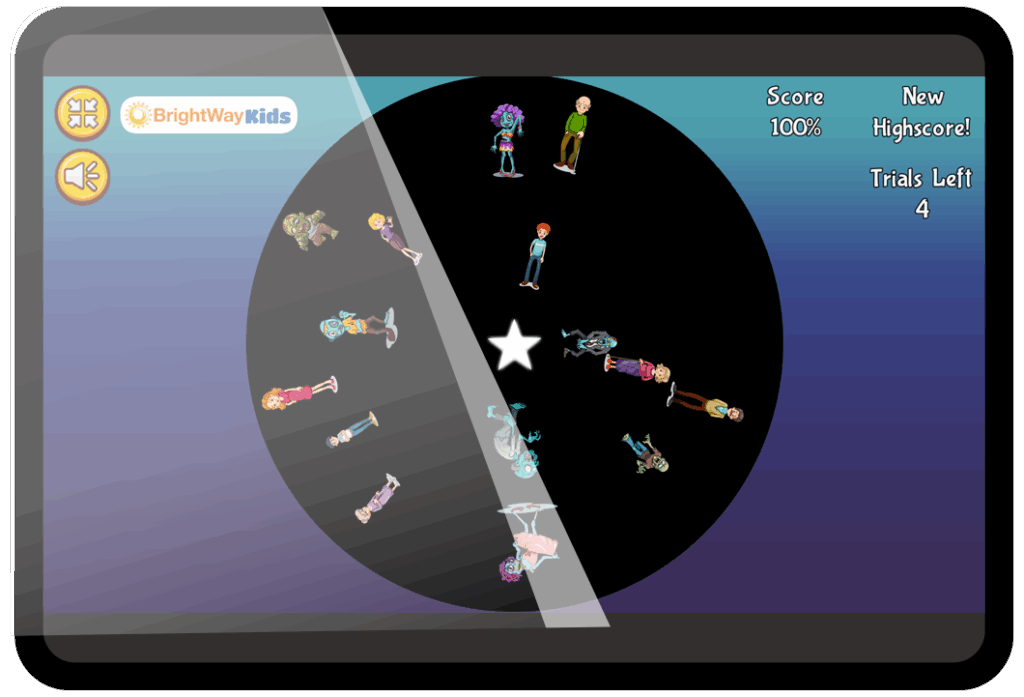
Visual tracking and attention games: Some interventions use action or arcade-style games to train the child’s visual attention and eye movement control. Interestingly, research has shown that even action video games can boost reading skills. In one clinical study, children with dyslexia who underwent visual-attention training via action video games significantly increased their reading speed. The fast-paced visuals trained them to orient their attention quickly across the screen, which translated into faster decoding of text. Our Visual Brain incorporates attention-challenging exercises (like “Frenzy,” a game that makes readers rapidly identify or sort words) to build this capacity. By strengthening the visual attention network, these games help readers take in more letters at a glance and reduce slow, letter-by-letter reading.
Sight word recognition via repeated visual exposure
Sight word recognition via repeated visual exposure: Computers excel at providing repeated, adaptive practice. Sight word programs present high-frequency words in engaging flashcard-style drills, sometimes with fun graphics or rewards.
This repeated visual exposure helps children store whole words in long-term memory (a process called orthographic mapping). As an example, Our Visual Brain’s “Sight Words Challenge” flashes common words in colorful, game-like quizzes, training the child to recognize them instantly.
Through consistent practice, what was once a laborious decoding effort becomes an automatic visual recognition. Research supports this approach: continuous, game-based training can greatly accelerate the development of reading fluency and word recognition, especially for low-skilled readers who need extra repetition.
Multisensory reading apps
Many computer interventions integrate visual, auditory, and even tactile elements – tapping into multiple senses to reinforce learning. For instance, a child might see a word, hear it spoken, and trace it on a touchscreen, all in one activity.
These multimodal experiences are especially effective for learners with dyslexia. They engage the brain’s visual pathways along with language areas, forming stronger connections. One program of this kind improved not only reading but also related skills like phonological memory by harnessing the plasticity of the brain’s multi-sensory networks.
BrightWay Kids games often pair visuals with sounds (like a picture or animation that appears when a word is read correctly), capitalizing on the brain’s ability to learn through multiple channels.
Adaptive feedback and reward systems
Adaptive feedback and reward systems: Computer interventions can maintain high motivation through immediate feedback and rewards. A child who might be reluctant with paper worksheets will often eagerly play a reading game that gives points, stars, or fun animations for each correct answer. This positive reinforcement loop encourages more practice. The emphasis on visual feedback – for example, a progress bar filling up or a character unlocking – taps into the brain’s reward circuitry, making learning enjoyable rather than frustrating. According to educators, the biggest hurdle for struggling readers is getting enough practice; engaging software can solve that by keeping the child invested in the activity.
Effective digital strategies emphasize visual learning
In summary, the most effective computer-based strategies for poor readers tend to share an emphasis on visual learning – whether through pictorial mnemonics, attention-training graphics, or interactive text – combined with adaptive, gamified practice. By playing to the strengths of our visual brain, these interventions help rewire the neural pathways for reading. They provide a safe, stimulating environment where children can make mistakes, get instant corrections, and try again, which is exactly the kind of intensive practice needed to overcome reading deficits.
Next up: Why digital strategies work
What’s different about computer-based games
Computerized reading programs accelerate learning by leveraging neuroplasticity, providing intensive, interactive practice that rewires the brain’s reading pathways. Their real-time feedback and adaptive difficulty keep students in the optimal challenge zone, ensuring mistakes are corrected immediately. With engaging visuals, gamified elements, and multisensory learning, these interventions boost motivation and make reading improvement both effective and enjoyable.