
Poor Reading: A Deep Dive
The science behind digital interventions for ADD/ADHD
The science behind computer-based interventions for ADD/ADHD
Computer interventions for ADHD are not just trendy – they work for clear neurological and psychological reasons. Firstly, games and interactive programs tap into the ADHD brain’s craving for novelty and stimulation. Children with ADHD have brains that are under-stimulated by mundane tasks; when something new or unexpected happens, their dopamine reward system lights up, improving their focus and motivationedgefoundation.org.
Digital games naturally provide this novelty: they present constant visual change, surprises, and rewards. This helps sustain the child’s attention in a way that worksheets or lectures cannot. In essence, the engaging visuals and sounds give the ADHD brain the “boost” it needs to stay tuned in.
Secondly, computer-based activities deliver immediate feedback and rewards, which is crucial for behavior change. ADHD often involves difficulty with delayed gratification, but games solve this by giving points, stars, or progress bars right after the child completes a task. This instant positive reinforcement encourages repetition and practice.
Over time, such practice can solidify new skills (much like drilling on flashcards, but far more fun). For example, if a child correctly types a word or holds attention on a target, the program might play a fun animation or level-up – providing a dopamine hit that reinforces their effort.
Thirdly, digital interventions can be personalized and adaptive. Good therapeutic software will adjust difficulty in real-time: if a child masters a level, the next one is slightly harder, and if they’re struggling, it might simplify or repeat the task. This keeps the challenge in the optimal zone – not so easy that it’s boring, but not so hard that it’s frustrating.
Such adaptation is something a human teacher or therapist does as well, but a program can do it continuously and objectively. The result is a tailored training for the child’s specific needs (e.g., focusing more on impulse control if that’s a major issue, or more on visual memory if needed).
This precision helps maximize improvement in the targeted skills. Fourth, technology allows for a multisensory learning experience. Many computer interventions combine visual, auditory, and sometimes tactile feedback (e.g., vibrating game controllers) to engage multiple senses.
This is beneficial because children with ADHD often learn better when information is presented in diverse ways. A multisensory game might read instructions aloud (auditory) while showing an example (visual) and requiring a keyboard press or gesture (kinesthetic). This redundancy increases understanding and retention.
Occupational therapists often use a multisensory approach in therapy; digital tools can do the same at home or in the classroom with consistency. In fact, researchers are exploring new technologies like virtual reality (VR) and mobile apps to help deliver interventions in real time and in engaging formatsnimh.nih.gov.
Finally, computer-based strategies reduce the stigma and boredom associated with therapy. To a child, playing a space-themed attention game or a puzzle adventure doesn’t feel like doing homework – it’s fun. This means they’re often more willing to practice regularly, which is key for improvement. The engagement factor can’t be overstated: one study noted that serious therapeutic games keep players motivated to continue “without the boredom or fear” that traditional tasks might evokemdpi.com.
Moreover, many of these games provide a safe environment to fail and try again, which builds resilience. If a child makes an impulsive move and “loses” the round, it’s just a game – they can reset and attempt again, learning from mistakes with no embarrassment.
Over time, these repeated trials can translate into real-world improvements. For example, a boy who learned to wait for the correct cue in a game might find it easier to raise his hand and wait to be called on in class, rather than blurting out. In summary, computer interventions work because they align with how the ADHD brain functions, offering stimulating, structured, and rewarding experiences that drive neuroplastic changes and teach crucial skills in an enjoyable way.
BrightWay Kids activities that address ADD/ADHD symptoms
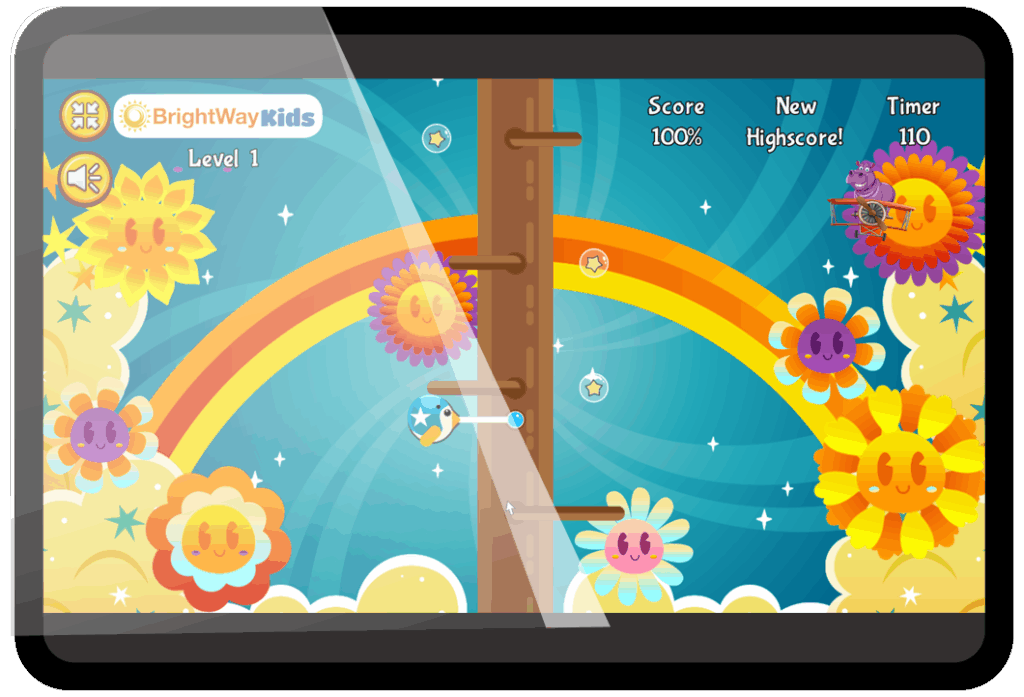
BrightWay Kids’s program includes a suite of therapeutic games designed to target core ADHD symptoms through visual and interactive means. Here’s how specific activities align with and improve each major symptom:
Inattention
Boosting Focus and Visual Sustained Attention: For children who are easily distracted, BWK uses visual attention games that train the brain to focus on relevant details for longer periods. One example is a visual tracking game where multiple objects move on the screen and the child must follow one target. This exercise forces the child to concentrate despite distractions, mirroring the classroom need to focus amid noise. By incrementally increasing the speed or number of distractors, the game strengthens the child’s attentional stamina. Why it helps: Such games exercise the frontal and parietal brain networks that control attention. Studies have found that game-based training can improve attention in children with ADHD, and we see this clinically – kids who regularly play these tracking games often show better focus on homework and reading. Offline complement: To reinforce this skill off-screen, parents and teachers can use activities like timed puzzle challenges or “I Spy” games in real life. For instance, doing a jigsaw puzzle or Hidden Pictures worksheet requires careful observation and can be used as a “brain warm-up” before writing tasks.
Hyperactivity
Channeling Energy through Visual-Motor Tasks: Rather than forcing kids with ADHD to “sit still” (which can be counterproductive), BWK activities for hyperactivity give them an outlet for movement in a controlled way. Our movement-based visual games require kids to perform physical actions in response to visual cues – for example, jump when a character on screen reaches a certain spot, or quickly tap a keyboard when a target appears. These tasks transform excess energy into purposeful responses. Over time, the child practices regulating when to move and when to hold back, improving their motor control.
Why it helps: It aligns with research showing physical activity can reduce hyperactive symptoms by improving self-regulation and arousal levels. By embedding movement into a visual game, we teach kids to associate certain visual signals with pausing or going, reinforcing body control. Offline complement: Incorporate short “energy burn” breaks that are visually guided – for example, use a visual timer or app that shows a cartoon character doing exercises for 5 minutes, and have the child follow along. Activities like martial arts or dance are excellent too; they are inherently visual (kids often watch an instructor’s movements) and have structured routines. Martial arts in particular has been shown to improve discipline and reduce hyperactivity through repeated practice of forms and movements.
Impulsivity
Improving Inhibitory Control via Visual Cues: To address impulsiveness, BrightWay Kids includes games that essentially teach waiting and thinking before acting. One flagship activity is similar to the classic “Red Light, Green Light” game: different colored signals appear, and the child must only respond (e.g., press a key or click) when the correct “go” signal is shown. If they respond on a red (stop) signal, the game provides gentle correction (and no point reward). This trains response inhibition – the ability to suppress the impulse to act prematurely. Another activity might involve strategic puzzles (like a chess-like game or resource management game) that require planning several moves ahead; impulsive actions in these games lead to quick failure, teaching through natural consequences.
Why it helps: These activities are grounded in evidence-based models for improving impulsivity. By consistently practicing inhibition in a fun context, children build the same neural pathways needed to control impulses in real life. Research on similar serious games found that they can indeed improve children’s ability to wait and make thoughtful choices, essentially prompting self-regulation.
Offline complement: Play hands-on games that reward self-control, such as Simon Says, Freeze Dance, or board games like Jenga that require careful, patient moves. For example, “Simon Says” is a great game of inhibition – the child can only do the action when preceded by “Simon Says…”, which directly exercises their impulse control. Such games have been noted to improve patience and rule-following in kids with ADHD. Additionally, simple techniques like a visual “traffic light” poster (with red = stop and think, yellow = decide, green = act) can be used as a reminder to slow down when a child is about to act rashly. Over time, coupling BWK’s impulse-control games with these real-world strategies greatly reduces impulsive behaviors.
Typing and visual writing aids
While not exclusive to “visual brain” training, teaching touch-typing on a computer can be a game-changer for students with dysgraphia. Typing programs use visual cues (on-screen keyboard guides, highlighting next letters) to help kids memorize key locations. This allows them to produce written work without the motor strain of handwriting, leveraging their often-strong visual memory of letter patterns on a QWERTY layout. Additionally, word prediction software and graphic organizer apps provide visual scaffolding: for example, seeing a mind-map of their essay or using drag-and-drop storyboarding can help an ADHD student organize thoughts more effectively than working abstractly on paper. These tools serve as visual prosthetics for executive function – the software holds the plan on screen, so the student’s visual system can guide the writing process.
Summary
Beyond the core triad, BrightWay Kids also addresses related challenges (like working memory and organization). For working memory, we have visual memory sequence games (e.g., repeating patterns, remembering locations of objects) to train the child to hold and manipulate visual information mentally. This translates to better recall of instructions and steps in tasks. For organization, we include games that involve sorting or categorizing visual items quickly, which maps to improved mental organization skills. Each symptom or skill area is paired with an activity that leverages visual strengths to improve weaknesses.
By engaging the “visual brain” in a targeted way, these activities make therapy enjoyable and effective, and each is designed to have a direct carryover into daily functional improvements for the child.
Next up: Moving minds and bodies
Why physical play still matters
Digital games are powerful—but physical activities are just as important. Explore movement-based games that support attention, regulation, and sensory needs in children with ADD.