
Poor Reading: A Deep Dive
BrightWay Kids activities that address dyscalculia
BrightWay Kids Activities that Address Each Symptom
The BrightWay Kids program includes specific activities engineered to tackle different dyscalculia symptoms by building the corresponding skills in a fun, visual way. Below is a list of key activities and how each one targets particular dyscalculia challenges:
Quick dot recognition (subitizing game)
This activity flashes a small number of dots on the screen briefly, and the child must identify how many dots were shown – without counting one-by-one. It directly addresses the symptom of poor number sense and subitizing (difficulty instantly recognizing quantities). By practicing with quick dot arrays, the child trains their brain’s ability to perceive quantity at a glance. Over time, this improves the intuitive grasp of “how many,” which helps with everything from recognizing that 4 is larger than 3 to understanding addition (since a problem like 2+3 can be seen as two dots and three dots combining). This activity is rooted in research that links dyscalculia to a deficit in the approximate number system – by repeatedly engaging that system, it aims to strengthen it. We clearly see progress when a student goes from needing to count, to just knowing the pattern “●●●● = 4” instantly. That reflects a true improvement in an underlying symptom.
Number line adventure
In this game, the child might help a character jump to the correct position on a number line or place numerical flags at the right spots. This targets magnitude estimation and spatial numerical reasoning issues. Dyscalculic learners often struggle to understand scales (e.g., that 8 is closer to 10 than to 2, or that 0.9 is almost 1) – essentially, their mental number line is unfocused. Number Line Adventure provides repetitive, visual practice in mapping numbers onto space. For example, it might ask the child to mark where “7” would go on a line from 0 to 10. With feedback and adjustment, the child gradually internalizes a more accurate mental number line. This improves their ability to estimate and compare numbers, addressing symptoms like difficulty with relative magnitude and placement of numbers. Notably, training on number lines has been shown to significantly improve children’s estimation abilities and even boost arithmetic performance, since a well-calibrated number sense underpins tasks like judging that an answer is reasonable. BrightWay Kids’s version of this uses engaging graphics (like a frog hopping to a lily pad numbered 7) to keep it fun while exercising the parietal lobe’s spatial-numeric mapping function.
Memory match (numbers and symbols)
This is a digital “cards face-down” memory game but with a twist: the cards might have numbers, dot patterns, or math symbols that the child needs to remember and match. It is designed to improve working memory for numerical information, directly addressing the symptom of forgetting math facts or sequences in the middle of tasks. A common dyscalculia complaint is “I lose track of what I’m doing” – this activity strengthens the memory buffer in the brain. By remembering where a 5 or “+” sign is located in the grid of cards, the child practices holding visual information. The game can be adapted to train memory of equations (e.g., match “3 + 4” with “7”) as the child advances, reinforcing math facts in a visual way. Research links dyscalculia to visuo-spatial short-term memory deficits, so improving that capacity means the child can better hold numbers in mind, whether to carry a digit in addition or to recall a multiplication fact. We often pair this with a strategy (like visualization or grouping) so the child isn’t just practicing memory but also learning how to remember (for instance, remembering 7 as a group of 3+4). Success in this game translates to real-life math: students become less likely to forget interim results or the steps they’re on in a multi-step problem.
Visual addition and fact fluency game
This activity presents basic addition or subtraction problems in a highly visual format. For example, it might show two groups of objects merging and have the student select the answer, or it might use a number line jump visualization for addition/subtraction. By coupling arithmetic facts with visuals, it aims to build automaticity in math facts – a known weak spot for dyscalculia (who often rely on counting for even simple facts). Unlike rote flash cards, BrightWay Kids’s approach always provides a visual anchor (like seeing 5 and 3 combine to make 8), which helps the brain encode the fact in multiple ways (symbolically “5+3=8” and visually as a pattern of 8). Over time, the visuals can be faded as the child starts to recall the facts from memory. This game often has a time element (encouraging slightly faster responses each time) to promote fluency once understanding is there. It addresses the symptom of slow, effortful calculation by gradually making basic calculations instantaneous and freeing up cognitive resources for harder problems. The visual aspect is especially helpful for kids who don’t learn well from verbal repetition – they might finally “see” why 7+2 is 9 and remember it, rather than just hearing it. As evidence of effectiveness, studies have noted that combining visual representations with traditional drills leads to better retention of math facts in students with math learning difficulties.
Pattern copy and spatial puzzles
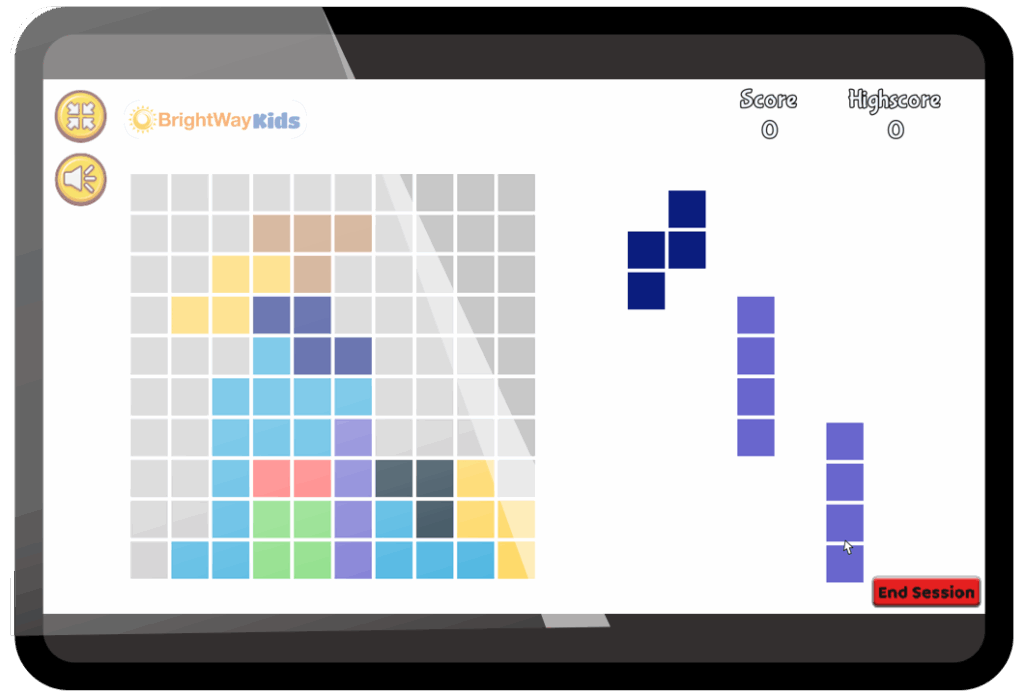
This is a set of activities where children reproduce or continue a visual pattern. For example, they might see a sequence of shapes or blocks and have to drag matching pieces to complete the pattern. While this might seem tangential to math, it directly tackles the visual-spatial and sequential reasoning deficits that many dyscalculic (and dysgraphic) learners have. The symptom of difficulty organizing work or aligning columns in math often stems from poor spatial organization skills. By doing pattern copy exercises, the child learns to pay attention to visual detail and sequence – skills needed for lining up numbers in multi-digit arithmetic or copying a geometry figure. Another variant is a block design game (akin to tangrams or puzzles) where the student must assemble a shape from parts. This strengthens mental rotation and spatial assembly skills, which can help in understanding place value (which has a spatial component in how digits shift with place) and even in reading charts/graphs. These activities support visual problem-solving and often build perseverance. Each pattern or puzzle solved is reinforcing an ability to see how parts fit into a whole – conceptually important in math (for instance, seeing 12 as composed of 5+7 or as a dozen items). In terms of dyscalculia symptoms, these activities address those more subtle issues like place value confusion, geometric reasoning problems, or even just the general disorganization that can hamper math work. By improving the brain’s visual structuring capacity, the student is better prepared to tackle structured math tasks. We clearly tie each puzzle to a skill: e.g. a symmetry drawing game might help with understanding mirror symmetry in geometry, or a spatial navigation game (guiding a character through a grid) could help with coordinates and mapping skills. All are designed to strengthen the “visual brain,” which in turn supports mathematical thinking.
Summary
Each BrightWay Kids activity has a clear purpose: to turn a specific weakness into a strength through practice and play. We also encourage students to articulate what they learned (even in simple terms) after each game, to ensure the skill carries over. For instance, after the Number Line game, asking “Which was bigger, 7 or 3? How could you tell on the line?” reinforces the concept in words. By targeting symptoms one by one, these activities collectively produce improvement in overall math performance and confidence.
Next up: Taking it offline
Physical games that build number sense
Not everything needs a screen. Discover movement-based games and hands-on activities you can do at home to help your child strengthen math-related skills in fun, active ways.