
Dyscalculia
Learn about the symptoms and causes of dyscalculia, why so many with this condition are struggling readers, and what you can do to help.

RECOGNIZE THE SIGNS
Recognize the signs your child might be struggling
CAUSES
Learn about the root causes and lead to reading difficulties
A guide to visual processing and why it matters
How BrightWay Kids helps make sense of numbers and math
Dyscalculia
The signs of dyscalculia issues
Dyscalculia symptoms present in many ways both at home and in the classroom that may be dismissed to the uninitiated:
Academic
- Difficulty with basic math
- Problems understanding numbers
- Trouble memorizing math facts
- Confusion with math vocabulary
Physical
- Tension and avoidance
- Delayed responses or freezing
- Frequent erasures or rewriting
- Difficulty with hand-eye coordination
What is dyscalculia?
Dyscalculia is a specific learning disorder in mathematics characterized by an inability to process numbers and calculations at an age-appropriate level, despite normal intelligence and schooling.
In neurological terms, it reflects atypical development in brain regions that handle numerical understanding (notably the parietal lobes). Individuals with dyscalculia struggle with basic number sense – the intuitive grasp of quantity and magnitude – which impairs their ability to learn arithmetic facts and procedures.
Causes of dyscalculia and how BrightWay Kids helps
Dyscalculia has neurological and cognitive origins. Research indicates it is multifactorial, meaning several interrelated factors in brain development and function contribute to the math difficulties. Key causes and theories include:
BrightWay Kids is a therapeutic gaming platform uniquely designed to address dyscalculia by targeting the root causes while making the learning process engaging and effective.
Fun games that address dyscalculia issues
Subscribe and get anytime access to the BrightWay Kids platform. Get the Dyscalculia monthly subscription – only $59.99 per month. Start or stop anytime.
How BrightWay Kids can help your child thrive
Daily dose of therapeutic fun
At BrightWay Kids, we believe that every learning challenge presents an opportunity for growth, creativity, and fun. Our activities are designed to engage children with dyscalculia in a playful and therapeutic way, focusing on essential skills like visual processing, number sense, and working memory. From games that reinforce math concepts through colorful visuals and interactive play to exercises that build confidence step by step, we create a positive and rewarding environment where children can thrive. We emphasize incremental successes, turning everyday challenges into moments of joy and accomplishment.
We understand your journey
Brain structure
Related symptoms
Difficulty with number sense, place value, and numerical relationships
Struggles with mental math, interpreting symbols, and applying math concepts
Trouble recalling math facts, even with repetition
Detailed explanation
Neuroimaging studies consistently identify the intraparietal sulcus (IPS) in the parietal lobe as crucial for processing quantities. Children with dyscalculia often exhibit atypical IPS activation, which impacts their ability to comprehend and manipulate numbers. Structural MRI studies, including research on genetic conditions such as Turner syndrome, highlight abnormalities in the IPS region and underscore the biological basis for dyscalculia. These disruptions create barriers to developing advanced math skills and confidence.
Connection to visual processing skills
Difficulties with spatial awareness and visual discrimination often compound challenges in aligning numbers or recognizing patterns. Targeted exercises can strengthen these skills and provide important support for math learning.
BrightWay Kids Activities
Auditory-Visual Matching Games
Strengthens the essential connection between what children hear and what they see, helping them quickly interpret spoken instructions and improving overall comprehension and responsiveness.

Balloon Counting
Why It Helps
Rapid, repeated visual number matching reinforces foundational brain connections responsible for intuitive number sense, helping children effortlessly understand and recognize quantities.
Description
Count balloons shown briefly on screen; quickly click the numeral that matches each group.
Sequencing
Improves children’s ability to remember, organize, and accurately act on auditory information, enabling them to follow directions more easily and manage multi-step tasks successfully.
Saccadic Trainer-Numerical Sequencing
Why It Helps
Strengthens rapid visual scanning and sequencing skills, helping learners quickly recognize numerical order, intuitively grasp number sizes, and confidently understand numerical relationships without needing to count each time.
Description
Quickly view a briefly flashed number sequence, then accurately tap the numbers in the correct order from a scattered display.
Multisensory Inegration Tasks
Enhances the brain’s ability to smoothly combine auditory information with visual and motor responses, allowing children to confidently and accurately handle complex instructions requiring simultaneous listening and doing.

Pipe Connect
Why It Helps
Builds key organizational skills such as planning ahead, remembering multiple steps, and carefully checking work—essential habits that enable children to confidently and accurately handle complex math problems.
Description
Connect matching color nodes with pipes, planning carefully so pipes never cross and the entire grid is filled exactly.
Representation
Magnitude Representation Deficit
Related symptoms
Trouble estimating quantities and understanding numerical relationships
Difficulty with mental math and interpreting math symbols
Struggles to connect numeric symbols (e.g., “5” or “9”) to their quantities
Detailed explanation
Dyscalculia often stems from a deficit in the approximate number system (ANS), responsible for intuitive numerical understanding. This impairment makes it challenging to perceive the difference between quantities, hindering the development of complex math skills. The symbolic access deficit further disrupts the connection between numeric symbols and quantities, affecting number sense.
Connection to visual processing skills
Weaknesses in visual-spatial processing impact number sense, leading to confusion with quantities, counting, and estimation. Strengthening these skills can help children better grasp numerical relationships.
BrightWay Kids Activities
Quantity Estimation Games
Build intuition for numbers and magnitudes.

Whack It
Why It Helps
Teaches quick recognition and sequencing of numbers, reinforcing intuitive magnitude sense through repeated visual-motor practice, making numeric order and quantity estimation more automatic and effortless.
Description
Watch numbered moles pop up; quickly tap or “whack” them in correct numerical order, reinforcing fast, intuitive magnitude recognition.
Symbol Matching Exercises
Enhance the Connection between symbols and quantities.

Match It-Visual Math
Why It Helps
Builds strong, lasting visual connections between numeral symbols and their represented quantities, enabling faster, more automatic recall of numbers and reducing reliance on slow counting strategies.
Description
Flip cards displaying numerals and visual dot-patterns; memorize locations to accurately pair numerals with corresponding quantities.
Visual Discrimination Tasks
Improve recognition of numbers and symbols.
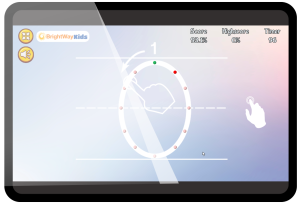
Trace It-Numbers
Why It Helps
Strengthens visual discrimination by building clear, detailed visual and motor memory templates of numerals, reducing confusion and helping children reliably and confidently distinguish numbers at a glance.
Description
Trace each numeral precisely along guided dots, using auditory pop cues as immediate feedback for accuracy and reinforcing strong visual recognition.
Executive function
Related symptoms
Trouble holding and manipulating numbers in mind
Difficulty with multi-step problems and logical reasoning
Slow, inconsistent progress on math tasks
Detailed explanation
Weak visuo-spatial working memory and poor inhibitory control contribute to math struggles. Children with dyscalculia may forget steps in long division or lose track of numbers. Executive function deficits make it challenging to focus, prioritize, and organize math tasks effectively.
Connection to visual processing skills
Poor visual-motor integration and sequencing skills often accompany executive function challenges, which can impact task completion.
BrightWay Kids Activities
Sequencing Drills
Enhance focus and impulse control.
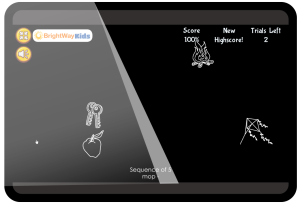
Sequencing-Text to Image
Why It Helps
Improves visual sequencing and working memory by requiring children to accurately recall and reproduce visual patterns and numerical sequences, directly strengthening the visual organization and memory skills essential for managing multi-step math processes.
Description
Watch a sequence of visual items (e.g., numbers, images, symbols) appear briefly; afterward, select the items in the exact order they were shown.
Memory Enhancement Games
Improve working memory and recall.

Memory Saccades-Ordinal
Why It Helps
Improves working memory updating and precise attention control by having children track sequences and identify specific ordinal positions, helping prevent common calculation errors caused by skipping steps or losing place.
Description
Watch targets flash in a sequence on-screen; after they finish, accurately identify and tap only the target in a specified position (e.g., third target).
attention Control Challenges
Building strategic planning and organizational skills.
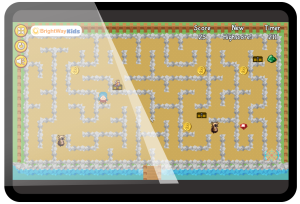
Maze Challenge
Why It Helps
Develops strategic planning, spatial reasoning, and organized problem-solving—critical skills for effectively arranging math computations and tackling multi-step numerical problems.
Description
Move your player carefully through the maze using directional controls, planning ahead to collect all required treasures and avoid obstacles to successfully reach the target at the maze’s end.
Genetic
BrightWay Kids Activities
Related symptoms
Persistent challenges with math despite practice
Avoidance of math tasks due to perceived failure
Difficulty learning math vocabulary and concepts
Detailed explanation
Dyscalculia has a genetic component, with studies showing a higher incidence in families. Genetic conditions such as Turner syndrome are linked to structural brain differences that affect numerical processing. Environmental factors, including stress or limited early exposure to numbers, can interact with neurological traits and influence the severity of dyscalculia.
Connection to visual processing skills
Genetic factors may impact visual memory and discrimination, making it hard to recall math facts or recognize patterns. Strengthening these skills can provide compensatory tools for learning.
Visual Memory
Enhance visual memory for math facts.
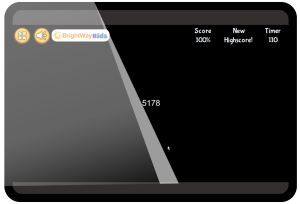
Tachistocope-Numbers
Why It Helps
Improves visual working memory and recall speed by briefly displaying numeric sequences, requiring children to memorize and accurately reproduce them—strengthening visual numeric recall and supporting automatic retrieval of math facts.
Description
Briefly view numeric sequences on-screen; after they disappear, accurately type or select the numbers in the correct sequence from memory.
Visual-Spatial Number Organization
Intuitively manage numerical sequences and numeric magnitudes.
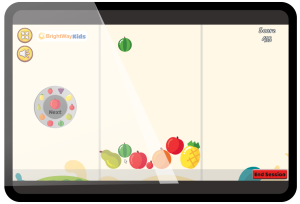
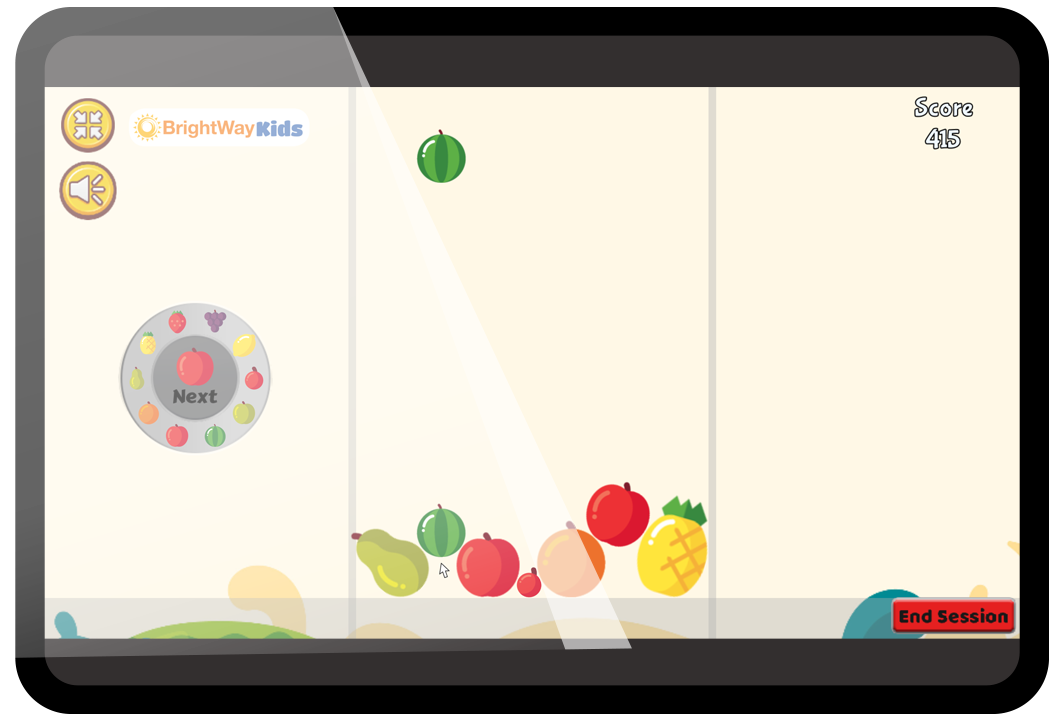
Fruit Merge
Why It Helps
Develops visual-spatial reasoning by challenging children to strategically organize numeric-like objects (fruits), reinforcing their ability to mentally group and visualize numeric quantities and relationships.
Description
Strategically place identical fruits into groups, merging them visually into larger fruits, continuously managing spatial relationships without filling the grid entirely.
Sorting and Categorization
Builds stronger visual understanding and intuitive grouping of numbers.
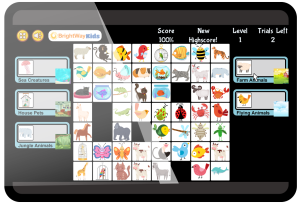
Sorting
Why It Helps
Enhances visual-spatial categorization and organizational skills by having children sort numeric or visual items into meaningful groups, reinforcing intuitive recognition of numeric sets and patterns.
Description
Drag and drop items into matching visual groups based on shared attributes, training rapid visual categorization and organizational skills.
We know that navigating the complexities of dyscalculia can feel overwhelming for both children and parents. BrightWay Kids is here to provide practical solutions, emotional support, and a personalized approach tailored to your child’s unique needs. We combine research-backed strategies with compassionate, engaging activities to empower children to overcome math challenges and develop lifelong skills. With BrightWay Kids by your side, you’re not just addressing learning difficulties—you’re unlocking your child’s potential and fostering a love of learning.

GET STARTED TODAY
Choose Unlimited or Connect and start today
BrightWay Kids offers constructed programs for struggling readers, or get the complete series with BrightWay Kids Unlimited:


Learn more about dyscalculia (math difficulties)
Research center
The science behind dyscalculia and digital games
How digital games target core brain systems associated with dyscalculia
Visual Processing and Dyscalculia
The connection between poor reading and math.
Dyscalculia and Dysgraphia
The link between handwriting and math.
Dyscalculia: Effective Online Strategies
Tech tools that support dyscalculia
Digital Games for Dyscalculia
Can games really help with math?
Dyscalculia: Effective Offline Strategies
Hands-on ways to boost brain skills.
Open the door to your child's future
Subscribe to BrightWay Kids and get anytime access with an online account. Your monthly unlimited subscription is $79.99. Start or stop anytime.
BrightWay Kids is a foundational tool to build reading skills
Our carefully designed platform provides deeply engaging, targeted activities for different learner needs. This holistic approach translates to better engagement and faster immersion into the world of reading.
BrightWay Kids isn’t a cure — and it’s not a diagnosis. But it is real, science-backed support that fits into your daily life. Because when your child’s brain gets the right kind of practice…reading starts to feel easier. And even fun