
Eye Tracking
Eye tracking skills are directly related to reading fluency. If your child is struggling with reading comprehension, eye tracking might the culprit.

Recognize the signs your child might be struggling
CAUSES
Learn about the root causes and lead to reading difficulties
A guide to visual processing and why it matters
How BrightWay Kids improves reading mastery
Eye tracking symptoms
The signs of eye tracking issues
Eye tracking problems present in many ways both at home and in the classroom that may be dismissed to the uninitiated:
Academic
- Skipping lines, words, or sections
- Frequent re-reading
- Difficulty aligning numbers
- Poor comprehension
Physical
- Eye fatigue or strain
- Erratic eye movements
- Double or blurred vision
- Angled, unusual posture when reading
How is an eye tracking problem defined?
The short answer is that the eyes do not work together in a well-controlled way. Eye tracking, or oculomotor function, refers to the brain’s ability to control and coordinate eye movements for smooth tracking of text or moving objects.
Causes of eye tracking problems and how BrightWay Kids helps
Eye tracking issues have several primary causes, all of which disrupt the normal coordination between the eyes and brain:
A therapeutic gaming platform like BrightWay Kids is uniquely designed to address eye tracking skills by targeting the root causes while making the learning process engaging and effective.
Fun games to build eye tracking skills
Subscribe and get anytime access to the BrightWay Kids platform. Get the Eye Tracking monthly subscription – only $79.99 per month. Start or stop anytime.
How BrightWay Kids can help your child thrive
Daily dose of therapeutic fun
At BrightWay Kids, we understand how challenging it is to watch your child struggle with reading. The frustration they feel—and that you experience alongside them—is a daily reminder of how important it is to find the right support. That’s why we’ve developed a therapeutic gaming platform designed to not only improve key academic and perceptual skills but also make the learning process enjoyable and rewarding for your child.
We understand your journey
We know the heartbreak of seeing your child feel defeated, of watching them avoid reading tasks because they associate them with failure. That’s why we’ve made it our mission to change that narrative. BrightWay Kids replaces frustration with excitement, turning learning into a positive experience for your child. As a parent, you’ll see the joy and pride they feel when they master new skills and overcome challenges.
Oculomotor
Related symptoms
Jerky or erratic eye movements
Frequent loss of place while reading
Complaints of eye fatigue or strain
Detailed explanation
Oculomotor dysfunction refers to weakness or lack of coordination in the muscles that control eye movements. These difficulties lead to irregular or inaccurate tracking, making it hard for children to follow text smoothly across a line. The effort required to compensate for these muscle deficiencies often results in physical discomfort, slow reading speed, and frustration. Over time, these challenges can negatively impact reading fluency and academic performance, as children struggle to focus on the content rather than the act of reading itself.
Connection to visual processing skills
Oculomotor dysfunction often occurs alongside deficits in visual processing skills, such as visual discrimination and memory. When the brain struggles to interpret visual information efficiently, the eyes may compensate with erratic or jerky movements, further exacerbating tracking issues. Strengthening visual processing can improve the brain’s ability to guide the eyes smoothly and accurately across text.
BrightWay Kids Activities
Pursuit Exercises
Engage children in following moving objects on the screen to improve the accuracy and smoothness of their eye movements.
Dino Adventure
Why It Helps
Builds smooth, left-to-right eye movement by guiding a moving character across the screen, much like the eyes follow text during reading. This strengthens reading fluency, reduces skipped words, and improves overall visual efficiency.
Description
Use arrow keys or taps to move the dinosaur forward, backward, or to jump, navigating obstacles while keeping focus on the path ahead.
Fixation Drills
Strengthen the ability to maintain steady eye focus on a single target.
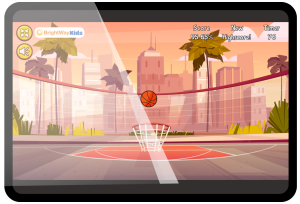
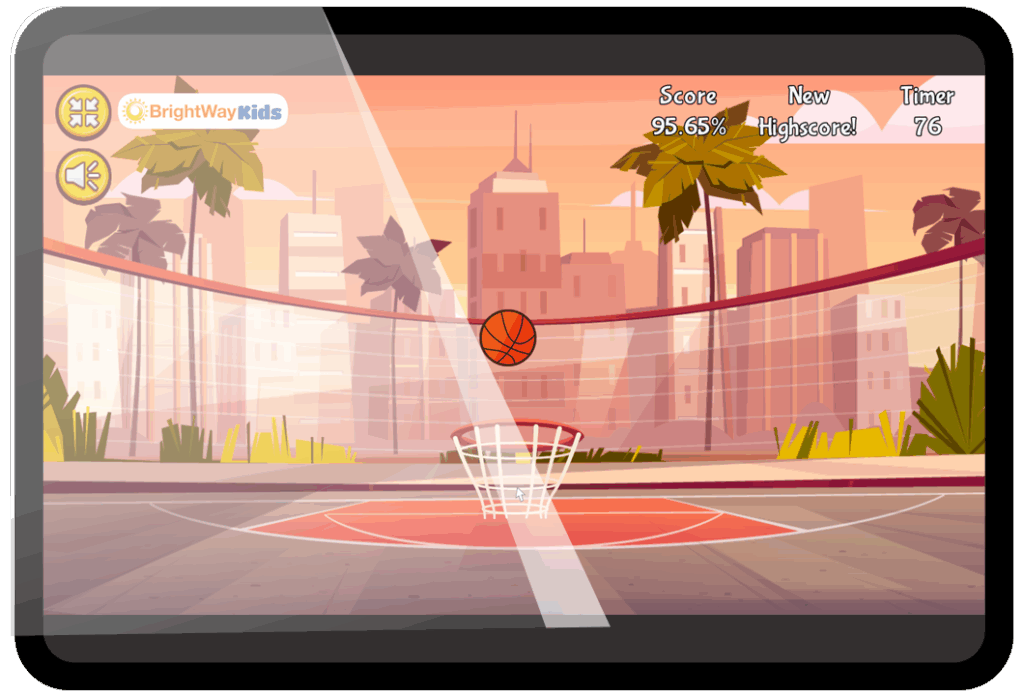
Hoops
Why It Helps
Improves the ability to keep eyes steady on a moving target, which helps children maintain focus on a word or problem until it’s processed.
Description
Move the basket with the arrow keys, mouse, or taps to catch falling balls without missing.
Saccadic Training Games
Develop rapid and precise shifts between visual points to reduce jerky movements.
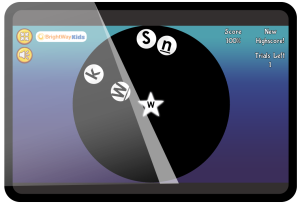
Saccadic Wheel-Visual Sequential Memory
Why It Helps
Trains quick, precise jumps between points on the screen, improving accuracy when shifting between words or lines of text.
Description
Watch the sequence of targets, then click them in the same order as they appeared.
Muscle control
Related symptoms
Head movement during reading
Complaints of tired eyes or double vision
Slow reading speed
Detailed explanation
Weakness in the extraocular muscles can cause eyes to wander or struggle to align properly, making smooth tracking difficult. This leads to compensatory behaviors, such as moving the head instead of the eyes or frequently losing place while reading. These symptoms are exacerbated during tasks requiring sustained focus, such as reading or copying from the board, and can lead to frustration and avoidance of visually demanding tasks.
Connection to visual processing skills
Weak eye muscle control often goes hand-in-hand with poor visual-motor integration, a key aspect of visual processing. The inability to coordinate eye movements effectively stems from the brain’s difficulty in processing and transmitting visual cues. Improving visual-motor integration can enhance the precision and strength of eye movements.
BrightWay Kids Activities
Pursuit Activities
Encourage smooth, controlled movements by having children follow dynamic targets.
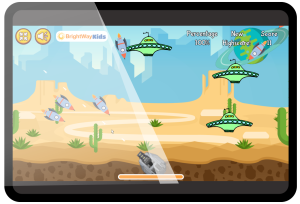
Kapow
Why It Helps
Encourages smooth, continuous tracking of moving objects, which is key for following words without losing place when reading.
Description
Click to launch shots at moving targets, keeping them in sight as they travel.
Alignment Challenges
Train eye coordination by aligning visual stimuli with on-screen prompts.
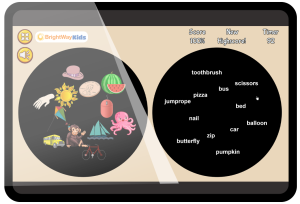
One Match
Why It Helps
Strengthens coordination between both eyes by requiring precise matching of targets, which supports better alignment when looking at text or numbers.
Description
Identify the single matching pair and click it before time runs out.
Eye Stamina Games
Gradually increase the duration of visual focus tasks to build endurance.

Cups
Why It Helps
Builds sustained attention by having children visually follow and track a moving object under the cups, increasing the endurance needed for longer reading or writing sessions.
Description
Watch closely to see which cup hides the ball, then click the correct one after they shuffle.
Vision
Binocular vision problems, such as convergence insufficiency, involve the eyes failing to work together as a team. These conditions can cause double vision, eye strain, or suppression of one eye. While BrightWay Kids activities can support visual processing skills, they are not a substitute for medical care when true binocular vision disorders are present.
Children experiencing persistent double or blurry vision, headaches during close work, or frequent eye rubbing should receive a comprehensive functional vision evaluation with a behavioral, developmental, or neuro-optometrist to determine the best course of treatment.
Neurological
Related symptoms
Skipping words or lines while reading
Difficulty sustaining attention on visual tasks
Poor hand-eye coordination
Detailed explanation
Neurological processing delays interfere with the brain’s ability to interpret and respond to visual information efficiently. These delays can result in frequent errors, such as misreading text or struggling to copy from the board. Children may appear inattentive or distracted due to the additional mental effort required to process visual input, further impacting academic performance.
Connection to visual processing skills
Delays in neurological processing often reflect inefficiencies in core visual processing skills, including discrimination, memory, and spatial awareness. These deficits disrupt the flow of information from the eyes to the brain, resulting in fragmented eye movements and inconsistent tracking.
BrightWay Kids Activities
Pursuit Tracking Drills
Develop smooth, steady eye movements by following a moving target, reducing skips and visual fatigue during reading.
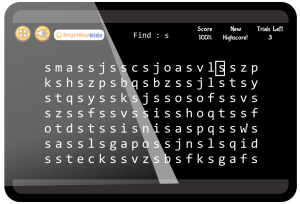
Tracking Suite
Why It Helps
Builds continuous, low‑effort pursuit so the eyes glide across text instead of “stuttering,” reducing loss of place and visual fatigue.
Description
Follow a single moving target smoothly with your eyes, keeping it centered as it changes direction and speed.
Speed Challenges
Develop faster visual responses by timing specific tracking and alignment tasks.
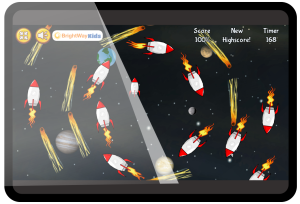
Speed Trainer-Peripheral Expansion
Why It Helps
Trains fast, accurate out‑and‑back saccades and return‑sweep control—key for staying on the correct word/line as tracking speed rises.
Description
Keep eyes anchored at the center; a brief target flashes in the periphery. Tap it quickly, then re‑center before the next cue. Increase pace/eccentricity as accuracy holds.
Memory Matching Games
Enhance the ability to recall and integrate visual information.
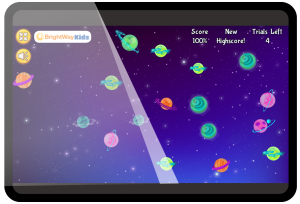
Memory Saccades-Sequential
Why It Helps
Couples spatial working memory with organized eye movements so saccades become purposeful and stable, improving line‑to‑line continuity.
Description
Watch targets light up in order, then reproduce the sequence by clicking them in the same order. Sequences lengthen as performance improves.
Saccadic control
Related symptoms
Repeatedly rereading the same line of text.
Misaligned columns in math problems.
Difficulty scanning for specific information.
Detailed explanation
Saccades are quick, precise eye movements between two points. Poor saccadic control results in skipping words or overshooting the target while reading. This makes text appear jumbled or disjointed, forcing children to reread frequently to grasp the content. This inefficiency not only slows reading speed but also reduces comprehension and confidence.
Connection to visual processing skills
Poor saccadic control often stems from deficits in spatial awareness and visual scanning, critical components of visual processing. When the brain struggles to guide the eyes between targets, it leads to disorganized and erratic movements. Strengthening these skills enhances the accuracy and efficiency of saccadic eye movements.
BrightWay Kids Activities
Saccadic Tracking Drills
Encourage rapid shifts between on-screen targets to improve precision.
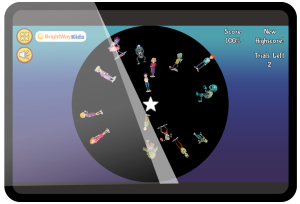
Saccadic Wheel-Visual Discrimination
Why It Helps
Trains fast, accurate jumps between peripheral targets and builds reliable, disciplined saccades so the eyes land precisely on each word/column.
Description
You are in a war against the zombies! Destroy your opponents by clicking or tapping on them.
Visual Scanning Games

Find It
Why It Helps
Improves systematic visual search and scanning efficiency, allowing students to locate information quickly (with fewer regressions and less rereading).
Description
Look at the objects along the side of your screen and then search the scene to find each one.
Accuracy Challenges
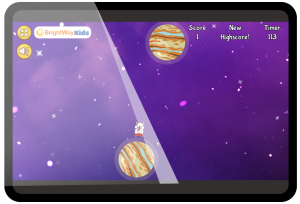
Rotational Sync
Why It Helps
Trains fast, accurate jumps between discrete targets while building sequencing, visual memory, and reaction timing — improving the precision of saccades and organized line/column scanning.
Description
Click or tap to move the target from one ball to the next and keep up with the rotating targets; if you miss a ball it’s Game Over.
Visual processing
Related symptoms
Misreading or reversing letters
Difficulty copying text accurately
Poor comprehension due to disrupted text organization
Detailed explanation
Visual processing disorders disrupt the brain’s ability to organize and interpret visual input. These impairments make it difficult to track letters and words across a page, leading to frequent reversals or skipped content. Without accurate tracking, comprehension suffers, as the child struggles to form a coherent understanding of the material. These challenges also impact writing and math tasks, where precise alignment is critical.
Connection to visual processing skills
Visual processing disorders are the root cause of many tracking issues. When the brain cannot accurately interpret visual input, it disrupts the sequence and flow required for reading and writing. Addressing these core processing deficits improves the brain’s ability to guide the eyes effectively.
BrightWay Kids Activities
Discrimination Exercises
Train children to differentiate between similar shapes or letters.
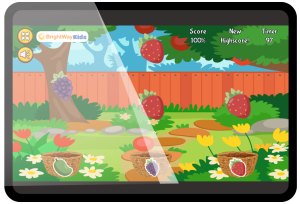
Tapout Fruit
Why It Helps
Trains precise feature discrimination so similar letters/shapes are less likely to be misread or reversed.
Description
Using your finger or the mouse, pop the bubble with the fruit that does not belong in each basket.
Letter Tracking Tasks
Reinforce the ability to follow text in sequence without skipping.
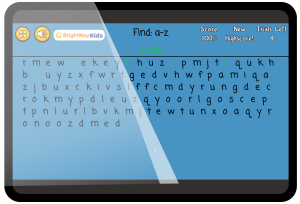
Speed Tracker
Why It Helps
Reinforces sequential letter-to-letter scanning and alignment so copying accuracy improves and reversals/skip errors decrease.
Description
Look at the top of the screen to identify the assigned targets. Then, starting at the top-left corner, tap the targets in the same order — focus on speed and accuracy. Remember to keep your head still and let your eyes do the work.
Organization Games
Develop skills for organizing visual information through interactive puzzles.
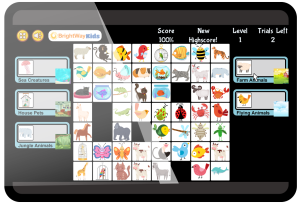
Sorting & Matching
Why It Helps
Builds visual organization and structured scanning so text and columns stay aligned, and comprehension improves.
Description
Sorting: drag and drop the center tiles into the correct box on the side of your screen
Matching: drag and drop the center tiles into the corresponding box on the side of your screen.
Vision evaluation
When to Seek a Functional Vision Evaluation
Some eye tracking problems go beyond what BrightWay Kids activities are designed to support.
Brain injury and neurological conditions: A concussion, traumatic brain injury, stroke, or conditions like Parkinson’s can disrupt the brain’s ability to coordinate eye movements. These changes affect the eye–brain communication needed for accurate tracking.
Visual/vestibular deficits: Sometimes tracking difficulties occur alongside balance or coordination challenges. In these cases, the issue is not weak eye muscles, but how the brain controls them.
Because these difficulties stem from neurological or multi-system factors, BrightWay Kids activities alone are not enough. Children and adults in these situations should have a comprehensive functional vision evaluation with a behavioral, developmental, or neuro-optometrist to determine the best course of care.
UNLOCK ADVENTURES IN CONFIDENCE
Choose one module or the whole series
BrightWay Kids offers focused programs for struggling readers, or get the complete series with BrightWay Kids Reading:


Learn more about eye tracking issues
Research center
Symptoms of Eye Tracking
Signs your child may be struggling.
Visual Processing in Handwriting and Visual Expression
The connection between poor reading and writing.
Eye Tracking and Dysgraphia
How visual skills affect handwriting.
Eye Tracking: Effective Online Strategies
Tech tools that support visual tracking.
Digital Games for Eye Tracking
Can games really help with tracking?
Eye Tracking: Effective Offline Strategies
Hands-on ways to boost visual skills.
Open the door to your child's future
Subscribe to BrightWay Kids and get anytime access with an online account. Your monthly unlimited subscription is $79.99. Start or stop anytime.
BrightWay Kids is a foundational tool to build reading skills
Our carefully designed platform provides deeply engaging, targeted activities for different learner needs. This holistic approach translates to better engagement and faster adoption to the world of reading.
BrightWay Kids isn’t a cure — and it’s not a diagnosis. But it is real, science-backed support that fits into your daily life. Because when your child’s brain gets the right kind of practice…reading starts to feel easier. And even fun.