
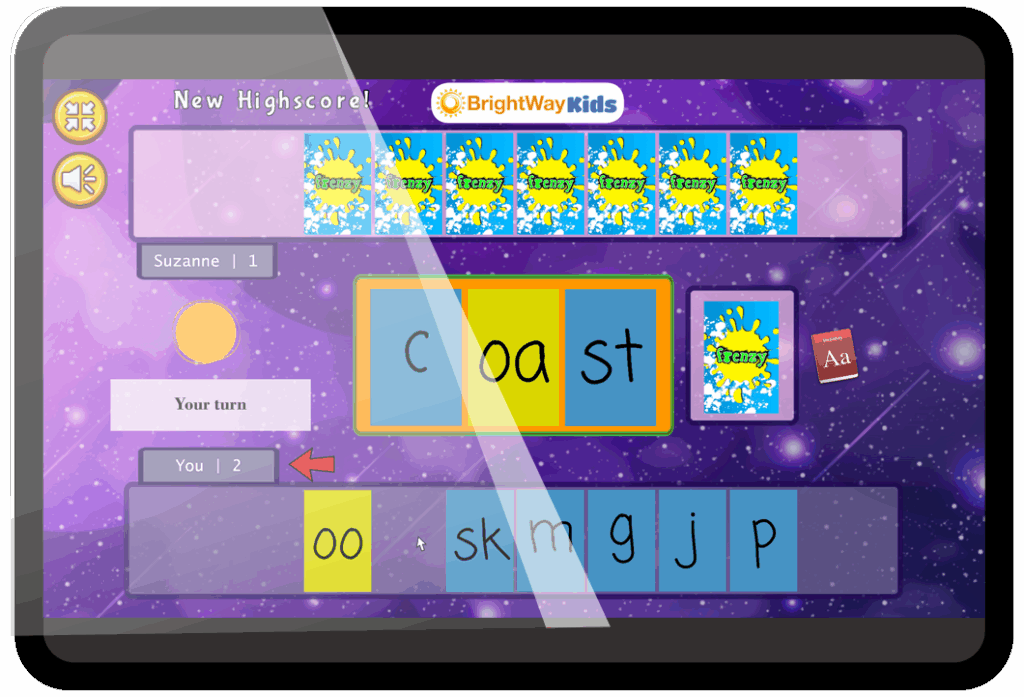
BrightWay Kids games that address dyslexia
BrightWay Kids activities that address dyslexia symptoms
The “BrightWay Kids” approach focuses on activities that engage visual processing to remediate dyslexia symptoms. Below, we match major dyslexia symptoms with specific BrightWay Kids activities, explaining how each activity improves that symptom:
Difficulty with phonological decoding (sounding out words)
BrightWay Kids Activity: Visual-Phonics Integration. This activity displays a large visual cue or animation for each phoneme (sound). For example, the sound “/m/” might be shown with an image of “mmm… yummy food” and the letter m morphing into that image. The child sees the visual and hears the sound simultaneously, and then traces the letter on screen. How it helps: It uses the child’s visual memory to reinforce phonological mappings. The strong visual association (image for the sound) creates a mental anchor for that phoneme, making it easier to recall. As a result, when decoding words, the child can remember “Oh, m makes the sound I saw in that picture” – bridging their phonological deficit with visual cues. This is aligned with multisensory teaching methods, and research indicates that such visual mnemonic support can improve phonological awareness and decoding accuracy. An offline complement to this is using letter tiles or flashcards with pictures (e.g., a card with “B” and a picture of a boat for /b/). The visual brain thrives on such concrete images, which bolster the abstract task of phonemic decoding.
Slow, laborious reading (poor fluency)

BrightWay Kids Activity: Rapid Visual Tracking and Chunking Game.
This game might present a highlighted bar that moves across text at a controlled pace (like a karaoke-style prompt) or a series of phrases that flash on screen which the child tries to read before they disappear.
Another variant is a “word stream” where words scroll and the child has to hit a key when they see a specific target word – training peripheral vision and quick word recognition.
How it helps:
These activities push the child to increase their visual processing speed and reduce word-by-word reading.
The moving highlight guides the eyes smoothly (preventing slow pauses), and the flashing phrases encourage visual chunking – recognizing multiple words at once.
In parallel, an offline strategy is repeated reading with a pacing card or metronome – essentially doing the same guided pacing but on paper.
Over time, the brain’s visual word recognition becomes more automatic, directly addressing fluency issues.
Poor spelling (orthographic deficits)
BrightWay Kids Activity: Visual-Spelling Memory Game. This could be a digital version of a memory card game: the child sees a word briefly and then it disappears, and they must recreate it with letter tiles on the screen.
Or a game where a word is shown and then scrambled, and the child has to reorder the letters correctly (relying on their visual memory of the word). Another activity is “fill in the missing letters” where a word flashes with some letters missing and the child chooses the correct ones. How it helps: These games strengthen the visual memory for word forms (the arrangement of letters in words).
By repeatedly exposing the child to a correct visual of a word and immediately challenging them to reproduce it, the brain’s orthographic mapping is exercised. This is critical for spelling, which requires one to recall how a word looks.
Research shows that focusing on visual orthographic training (like visualizing and recall) can significantly improve spelling in dyslexic learners, especially for irregular words that can’t be sounded out.
Essentially, the child’s “visual lexicon” of words expands, leading to more accurate spelling and quicker recognition during reading. Offline, a similar approach is to use flashcards: show a word, take it away, have the student write it from memory, then compare.
The digital version adds fun and adaptive difficulty (e.g., starting with smaller words and building up), making the visual brain work systematically to store written words.
Letter reversals and confusing visually-similar letters
BrightWay Kids Activity: Mirror Letter Training.
This is a set of exercises specifically targeting letter discrimination. One activity might be a “b/d/p/q” sorting game: various orientations of these letters appear, and the child must drag each into the correct box (e.g., box labeled “b” vs “d”).
Another could be a game where the child must trace or draw the letter in the correct orientation to “zap” a mirrored monster version of it – giving a fun narrative to practicing orientation. How it helps: By giving intensive practice in distinguishing mirror-image letters, the child’s visual cortex becomes more attuned to the subtle differences (like the direction of the letter’s loop or stem).
The immediate feedback (the game only accepts correctly oriented letters) helps retrain any neural confusion between mirrored forms. Studies in visual perception suggest that training visual discrimination can reduce errors like letter reversals in writing.
Essentially, it teaches the brain that “b” and “d” are as different as, say, “p” and “q,” solidifying those neural pathways. As the child’s visual feature detection improves, we see fewer reversal errors, improving both reading accuracy and handwriting.
A complementary offline activity is using tactile methods: e.g., have the child trace letters in sand or form them with clay, always verbalizing “b has the bat before the ball, d has the drum after the stick” – engaging visual and motor memory together.
Over time, the combination of digital and tactile practice dramatically reduces confusion between similar letters.
Slow recall of words and naming (rapid naming deficit)
BrightWay Kids Activity: Rapid Image-Word Association. This activity shows a series of pictures or symbols at increasing speed; the child has to either name them out loud or press a key corresponding to the right word.
For example, images of common objects might flash and the child says the name, or a mix of letters and numbers appear and they must quickly press the matching key.
Another variant is a timed category naming game: “Name as many animals as you see” while animal pictures pop up randomly. How it helps: These exercises target the brain’s rapid retrieval circuits by creating a game around speed of visual recognition and verbalization. They effectively practice the same skill as rapid automatized naming (RAN) tests, but in an engaging way. By repeatedly exposing the child to quick visual stimuli and requiring instant naming, the brain’s processing speed and cross-modal (visual-to-verbal) connection strengthen.
Improved RAN is linked to gains in reading fluency because the child becomes faster at recalling the names of letters and words. Think of it as greasing the wheels of the brain’s word-finding engine. Empirical studies have noted that training processing speed and naming can modestly improve reading rates in dyslexic children.
Offline, clinicians sometimes use naming drills (e.g., flash a card and have the child name it as fast as possible, or use a metronome to pace naming common objects). The BrightWay Kids game simply makes this training more fun and trackable. As a result, the child who used to pause when seeing a letter “F” and thinking “uh… that’s F” will start to immediately recognize and say “F”, which in reading translates to less halting at each word.
Summary
By addressing each core symptom with a specific visual-brain-based activity, we are essentially rewiring the brain systems that are weak. Each activity uses visual stimuli or visual-motor interaction as the primary mode of training, capitalizing on the brain’s plasticity. Notably, these activities often yield improvements beyond the targeted symptom. For example, the mirror letter training not only fixes reversals but also improves overall reading accuracy; the visual memory game for spelling also boosts sight-word reading. The approach is holistic in engaging the child’s visual strengths to support their language weaknesses, resulting in a more balanced skill set.
Next up: Off-screen, still on-track
From Skill to Strategy—How to Support Visual Processing for Better Handwriting
Now that we understand how visual processing fuels handwriting and visual expression, the next step is knowing what to do about it. How can parents, educators, and therapists help strengthen these skills? What kinds of activities and interventions are most effective for boosting visual memory, attention, or motor integration? In the next section, we’ll dive into practical, research-backed strategies that support kids with visual processing challenges—and show how small changes can unlock clearer, more confident writing.